


What is CICD pipeline?
A CI/CD pipeline is a series of steps that must be performed in order to deliver a new version of the software
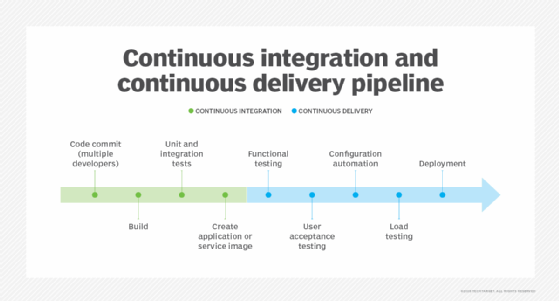
A CI/CD pipeline introduces monitoring and automation to improve the process of application development, particularly at the integration and testing phases, as well as during delivery and deployment. Although it is possible to manually execute each of the steps of a CI/CD pipeline, the true value of CI/CD pipelines is realized through automation.
Elements of a CI/CD pipeline
The steps that form a CI/CD pipeline are distinct subsets of tasks grouped into what is known as a pipeline stage. Typical pipeline stages include:
- Continuous Integration
- Build
- Test
- Merge
- Continuous Delivery
- Automatically release to repository
- Continuous Deployment
- Automatically deploy to production
Before continuous integration
Manually compiling source files, packaging them and updating database schemas cost software teams a lot - both in terms of development effort, as well as development time and cost.
Any software application that is developed with longer periods between integrations is sure to make it exponentially more difficult to find and fix problems.
After Continuous Integration
Developer --- push code --- CI Server[build,test,deploy]
Continuous Integration = Continuous build + continuous test
CI/CD pipeline

| Plan | Deploy Chef, Puppet, Ansible, Terraform etc. |
| Code github, gitlab | Operate |
| Build Maven,gradie etc. | Monitor Nagios, grafana |
| Test selenium,Junit etc. |
We've a tool for integrating all these tools and work steps.
Alternatives of Jenkins:
What is Jenkins?
Workflow of Jenkins
Advantages of Jenkins
About the author
Hello! My name is Tushar and I'm a passionate Developer from India with a strong interest in Cloud-Native technologies. I mostly work on backend development, automating and optimizing critical deployments using various development and Cloud-Native technologies.
Comments
Join the discussionNo comments yet. Be the first to comment.


